Why Now Might Be the Right Time to Start a Career in Game Art
Vertex School explains how periods of industry disruption can create an opening for new game artists who master both the fundamentals and the workflows studios increasingly expect.
There probably hasn't been a more confusing time to consider starting a career in game art.
It's starting to become nearly impossible to separate conversations about the future of creative work from conversations about the rise of AI tools. For someone looking at game art from the outside, waiting until the dust settles might seem like the safest option. But game development has never really had a moment when the tools stopped changing.
Transitions Create Opportunities
The transition from predominantly hand-built workflows toward digital sculpting transformed character production. ZBrush made workflows possible that would have been impractical with earlier modeling techniques. Substance Painter and the broader adoption of physically based rendering changed how artists approached materials and texturing. Real-time engines increasingly became the place where artists didn't simply deliver assets, but assembled environments, lit scenes, and presented finished portfolio work.
Each transition required established artists to learn something new. But it also gave newcomers something unusual: an opportunity to learn the emerging workflow from the beginning rather than having to unlearn years of an older one.
Nobody can say with certainty exactly how AI will fit into game production five years from now. Individual studios are adopting, restricting, and experimenting with the technology in very different ways. The legal and ethical questions aren't going away, either.
What we can say with considerably more confidence is that the tools used to make games will continue changing. And beneath those tools, many of the skills that studios expect from game artists remain remarkably familiar.
A compelling environment still requires an understanding of composition, scale, modularity, materials, lighting, and visual storytelling. A production-ready character still needs believable anatomy and proportions, efficient topology, carefully constructed UVs, convincing materials, and a clear design.
Knowing which button produces an asset isn't the same thing as understanding why that asset works or what makes it appealing to the human eye. That's why a professional portfolio review doesn't simply ask which software an artist knows.
Artists are evaluated on modeling accuracy and proportions, topology efficiency, UV layouts and texel density, material definition, lighting, composition, presentation, and the ability to tell a story through the finished work.
Those are also the criteria Vertex School uses when evaluating capstone projects in its Game Art Program. The software is part of the pipeline. The fundamentals are what allow an artist to move between pipelines.
That distinction becomes increasingly important when the pipeline itself is changing quickly.
A Modern Approach to Learning Game Art
Vertex School's approach is therefore built around teaching a complete modern production workflow for students who apply to the program rather than training students around a single application. The nine-month online Game Art Program begins with shared Game Art Foundations before students specialize in either Environment Art or Character Art.
The Foundations portion takes students through high-resolution and game-resolution modeling, UV unwrapping and layout, PBR texturing with Substance Painter, ZBrush sculpting fundamentals, and lighting and rendering using Marmoset and Unreal Engine. Students bring those skills together in a Prop Capstone before moving into their specialization.
For Environment Art students, that means going deeper into blockouts and modular design, mid-poly workflows, tileable textures, trim sheets, terrain and foliage systems, Megascans, and lighting and composition inside Unreal Engine. The track culminates in two complete environment projects, including a larger final environment intended to serve as a flagship portfolio piece.
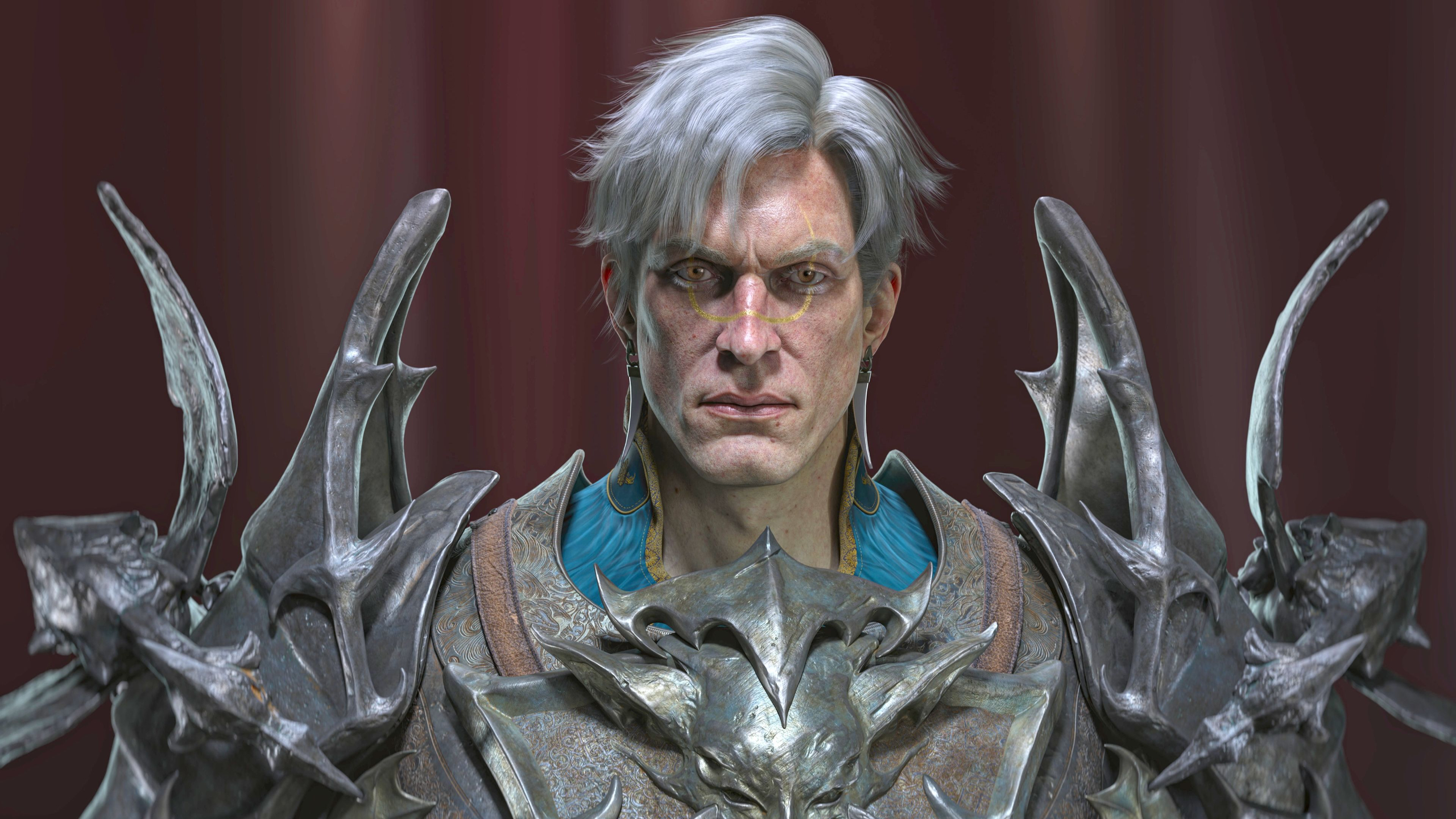
Character Art students instead move deeper into facial and body anatomy, sculpting, clothing creation with Marvelous Designer, retopology for game-resolution characters, skin, eye, and clothing texturing, hair creation using tools such as XGen and Blender, and final presentation in Marmoset and Unreal Engine. Their track culminates in a complete character capstone.
The common thread isn't simply learning software. It's understanding how an asset moves through an actual game art pipeline. That distinction matters because software inevitably changes.
An artist entering the industry today may spend the next several decades watching today's dominant tools get replaced, reinvented, or supplemented by technologies that don't exist yet. Being employable over that period requires more than memorizing a workflow. It requires understanding the artistic and technical principles underneath it well enough to adapt when the workflow changes.
Mentorship is another major part of Vertex's approach. Students receive one-on-one and small-group guidance from industry professionals, including mentors with experience at studios such as CD Projekt Red, Splash Damage, Massive Entertainment, Xbox Studios, and Blizzard. Vertex School is also an Unreal Authorized Training Center, with students receiving an official certificate after completing the program.
Check out some of the student success stories right here.
Don't Wait for the Right Time
But there is another factor that matters during a period of rapid technological change: time.
Traditional degrees can take several years. Vertex's Game Art Program lasts nine months and is explicitly career-focused, with students expected to dedicate at least 20 hours per week and preferably 30 or more. The compressed format is designed around building production skills and portfolio pieces quickly rather than spreading the process across a multi-year curriculum.
That doesn't make becoming a professional game artist easy.
The portfolio bar remains high. Strong fundamentals take considerable practice. AI won't eliminate the need to understand anatomy, topology, materials, lighting, composition, or storytelling, and simply knowing the latest software won't make someone employable. But uncertainty doesn't necessarily mean newcomers should wait.
Game development has always been an industry where yesterday's specialized technology eventually becomes today's standard workflow. Artists who entered during the rise of digital sculpting learned ZBrush. Artists entering during the PBR transition learned tools like Substance Painter. As real-time workflows became increasingly important, artists learned to build, light, and present their work directly inside game engines.
Nobody yet knows exactly where that shift ends. The more durable strategy for an aspiring artist may therefore be neither rejecting every new tool nor chasing every new piece of technology that appears.
It's building the artistic fundamentals that survive those changes while remaining curious enough to learn what comes next.
Vertex School's next Game Art Program term begins September 28, 2026, with enrollment currently open. The program is online, beginner-friendly, and offers dedicated Environment Art and Character Art tracks following its shared foundations curriculum. View the syllabus now to see exactly what you'd be signing up for.
Visit Vertex School's website to learn more and enroll today.